
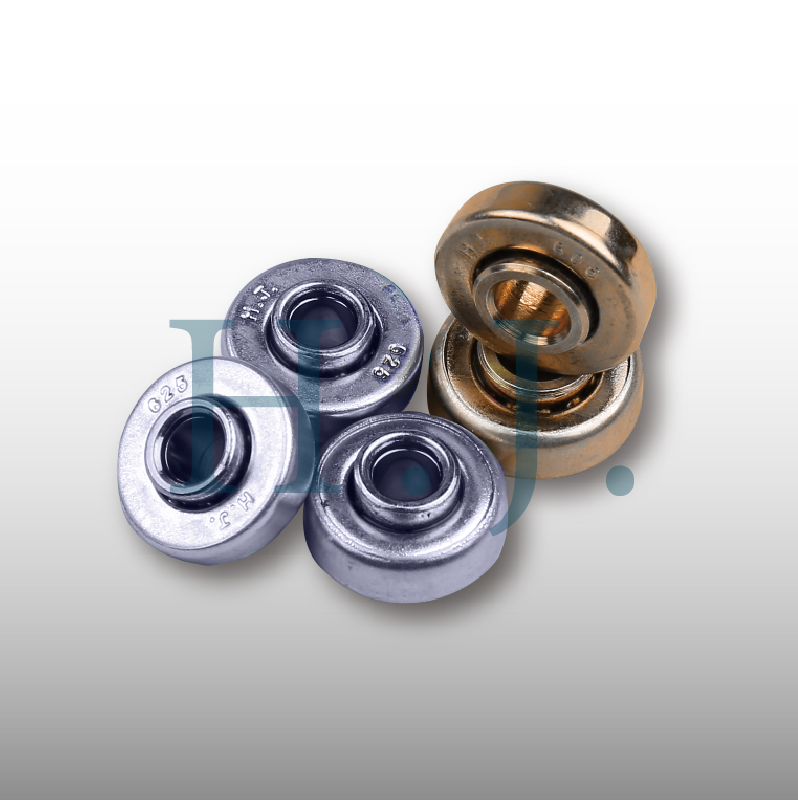
 Medical device precision rollers
Medical Device Precision Rollers – Custom Roller and Bearing Solutions for Precision Medical Equipment
Medical device precision rollers are specialized mechanical components used to support, guide, transfer, position, or rotate parts within medical equipment and precision healthcare-related machinery. These rollers may incorporate ball bearings, slide bearings, special bearing structures, plastic components, shafts, or custom housings depending on the equipment design.
In medical equipment, smooth and controlled mechanical movement can be important for equipment performance and user experience. Precision rollers may be used in positioning systems, sliding mechanisms, guide systems, equipment drawers, adjustment units, mobile equipment, diagnostic machinery, and other moving assemblies.
HSIAN JI BEARING CO., LTD. is a Taiwan bearing manufacturer established in 1995. The company mainly develops and produces Taiwan-made steel ball bearings and slide bearings and also provides plastic bearings, stamped bearings, thrust bearings, special bearings, and non-standard bearings. Medical equipment is directly listed among the applications for multiple HSIAN JI bearing categories.
For customers requiring medical device precision rollers, HSIAN JI can evaluate custom roller and bearing projects according to engineering drawings, physical samples, roller dimensions, bearing dimensions, shaft size, required precision, load, movement, speed, materials, operating environment, and production quantities.
What Are Medical Device Precision Rollers?
Medical device precision rollers are rollers designed for equipment where controlled movement and dimensional consistency are important.
A typical roller assembly may include:
-
Roller body
-
Bearing
-
Shaft
-
Axle
-
Spacer
-
Housing
-
Retaining component
Depending on the application, the roller may rotate around a fixed shaft or move together with another mechanical assembly.
What Do Precision Rollers Do in Medical Equipment?
Precision rollers can perform different functions, including:
-
Guiding movement
-
Supporting loads
-
Reducing friction
-
Transferring components
-
Controlling travel
-
Supporting positioning mechanisms
-
Enabling smooth rotation
The exact function depends on the medical equipment design.
Why Is Precision Important?
Medical equipment can use compact mechanisms where small dimensional differences affect movement.
Important characteristics can include:
-
Roller diameter
-
Concentricity
-
Shaft fit
-
Bearing fit
-
Width
-
Runout
-
Alignment
Poor dimensional control may create noise, vibration, uneven movement, or premature wear.
HSIAN JI Precision Bearing Capabilities
HSIAN JI's Slide Bearings information states that slide bearings can provide high-precision linear motion and high rigidity. Medical equipment is also specifically identified as an application.
Its Ball Bearings information also highlights relatively high running accuracy due to low rolling friction.
These characteristics provide a relevant foundation for custom precision-roller projects.
Ball Bearings for Medical Precision Rollers
Ball bearings can be integrated into roller assemblies where low-friction rotation is required.
Potential benefits include:
-
Smooth rotation
-
Low rolling resistance
-
Stable movement
-
Compact construction
-
Repeated operation
Important specifications include:
-
Bearing ID
-
Bearing OD
-
Bearing width
-
Load
-
Speed
-
Lubrication
-
Precision
The bearing should be evaluated together with the roller and shaft.
Slide Bearings for Medical Device Mechanisms
Not every precision mechanism requires a rotating ball-bearing roller.
Slide bearings can support and guide linear movement.
HSIAN JI identifies medical equipment, including MRI and X-ray equipment, among applications for its Slide Bearings.
Potential uses can include:
-
Sliding guides
-
Positioning systems
-
Adjustment mechanisms
-
Linear movement assemblies
Plastic Precision Rollers
Engineering plastics may be considered for certain roller components.
Potential advantages can include:
-
Reduced weight
-
Corrosion resistance
-
Lower noise
-
Design flexibility
Material suitability depends on:
-
Load
-
Wear
-
Temperature
-
Cleaning chemicals
-
Movement frequency
Plastic should not automatically be assumed suitable for every medical application.
Custom Medical Precision Rollers
Standard rollers may not fit proprietary medical-device mechanisms.
Customization can involve:
-
Roller diameter
-
Roller width
-
Bearing bore
-
Bearing OD
-
Shaft diameter
-
Groove profile
-
Flange geometry
-
Mounting features
Engineering drawings are strongly recommended.
Small Precision Rollers for Medical Devices
Compact medical equipment may require small rollers.
Applications can include:
-
Small positioning systems
-
Compact guides
-
Equipment drawers
-
Adjustment mechanisms
-
Portable equipment
Small roller dimensions require precise fit between the bearing, shaft, and surrounding structure.
Miniature Medical Device Rollers
Miniature roller assemblies may be required where installation space is extremely limited.
Customers should provide:
-
Available space
-
Roller OD
-
Shaft diameter
-
Load
-
Speed
-
Required travel
-
Precision requirement
The smallest possible roller is not always the best mechanical solution.
Low-Noise Medical Device Rollers
Noise can be important in medical and healthcare environments.
Roller noise may be affected by:
-
Bearing precision
-
Roller material
-
Shaft alignment
-
Lubrication
-
Surface finish
-
Load
Low-noise requirements should be defined during design.
Low-Friction Precision Rollers
Low friction can help provide smooth operation.
Potential applications include:
-
Positioning mechanisms
-
Equipment guides
-
Sliding assemblies
-
Adjustable systems
The complete assembly affects friction, not only the bearing.
Medical Equipment Guide Rollers
Guide rollers can help maintain the position of a moving component.
Potential applications include:
-
Equipment rails
-
Positioning systems
-
Sliding mechanisms
-
Mechanical guides
Important characteristics include alignment, roller profile, precision, and load.
Medical Equipment Transfer Rollers
Some equipment may use rollers to transfer parts or components between mechanical positions.
Transfer rollers may require:
-
Smooth rotation
-
Accurate dimensions
-
Stable alignment
-
Consistent surface contact
The application should be evaluated according to the transported component.
Medical Device Positioning Rollers
Positioning systems can require repeatable mechanical movement.
Precision rollers can help guide components toward defined positions.
Important specifications may include:
-
Runout
-
Roller diameter
-
Shaft fit
-
Bearing clearance
-
Load
Rollers for Diagnostic Equipment
Diagnostic equipment can contain various moving mechanisms.
Potential applications can include:
-
Guide systems
-
Positioning mechanisms
-
Sliding assemblies
-
Adjustment units
The exact bearing and roller design depends on equipment specifications.
Rollers for Medical Imaging Equipment
Medical imaging equipment may require smooth and accurate movement.
HSIAN JI's Slide Bearings page specifically lists MRI and X-ray equipment as medical applications.
However, a roller or bearing should not automatically be described as MRI-compatible unless the full material and magnetic requirements have been evaluated.
Rollers for Medical Equipment Drawers
Medical carts and cabinets may use rollers in drawer mechanisms.
Important requirements can include:
-
Low noise
-
Smooth movement
-
Repeated operation
-
Compact dimensions
-
Load support
Custom roller assemblies can be evaluated for proprietary drawer systems.
Rollers for Adjustable Medical Equipment
Adjustable equipment may use precision rollers in mechanisms that change:
-
Position
-
Height
-
Angle
-
Component location
Roller dimensions and alignment can influence movement quality.
Rollers for Mobile Medical Equipment
Mobile medical equipment may use rollers in internal mechanisms, drawers, guides, and accessories.
The requirements can vary widely according to function.
Each project should be evaluated individually.
Corrosion-Resistant Medical Rollers
Medical equipment may be exposed to:
-
Humidity
-
Cleaning agents
-
Water
-
Disinfectants
Potential material approaches can include:
-
Stainless steel
-
Engineering plastics
-
Application-specific materials
Chemical compatibility should be specified.
Stainless Steel Precision Rollers
Stainless steel can be considered where corrosion resistance is important.
Customers should provide:
-
Required stainless grade
-
Cleaning environment
-
Load
-
Surface requirements
-
Precision requirements
Different stainless-steel grades have different properties.
Sealed Bearings for Medical Rollers
Sealed bearings can help reduce contamination entering the bearing.
Potential contaminants include:
-
Dust
-
Fibers
-
Moisture
-
General debris
However, seals can increase friction.
The complete application must be considered.
Roller Surface Finish
Roller surface finish can affect:
-
Contact behavior
-
Noise
-
Wear
-
Movement smoothness
If a critical surface finish is required, it should be stated on the drawing.
Roller Concentricity
Concentricity can be important where the roller rotates at relatively high speed or guides precision movement.
Poor concentricity can cause:
-
Vibration
-
Uneven contact
-
Noise
-
Positioning error
The required tolerance should be defined numerically.
Roller Runout
Radial runout can influence rotational accuracy.
Precision applications should specify acceptable runout rather than using only general terms such as "high precision."
Shaft Fit for Precision Rollers
The shaft and bearing fit must be carefully controlled.
Incorrect fit may result in:
-
Looseness
-
Excessive interference
-
Heat
-
Noise
-
Poor rotation
Shaft tolerances should be supplied with the bearing drawing.
Roller Bearing Fit
The fit between the bearing and roller body is equally important.
An incorrect press fit can deform the bearing or allow unwanted movement.
The roller bore and bearing OD should be designed together.
Precision Roller Materials
Possible roller materials depend on application.
Material selection can consider:
-
Strength
-
Wear
-
Corrosion
-
Weight
-
Noise
-
Cleaning environment
The customer should identify any mandatory material.
Medical Device Precision Rollers from Drawings
Engineering drawings provide the best basis for development.
Customers can submit:
-
2D technical drawings
-
3D CAD models
-
Roller drawings
-
Bearing drawings
-
Shaft drawings
-
Assembly drawings
-
Material specifications
-
Tolerances
Critical characteristics should be clearly marked.
Precision Rollers from Physical Samples
If original drawings are unavailable, a physical sample can provide useful dimensional information.
A sample can help identify:
-
Roller size
-
Bearing dimensions
-
Shaft size
-
Groove geometry
-
Assembly structure
Application requirements should also be provided.
Prototype Medical Precision Rollers
Prototype development can help confirm a new design.
Testing may include:
-
Dimensional fit
-
Runout
-
Rotation
-
Noise
-
Load
-
Movement
-
Assembly compatibility
Actual equipment testing is recommended.
OEM Medical Device Precision Rollers
Medical equipment manufacturers may require proprietary roller assemblies.
OEM projects can involve:
-
Customer drawings
-
Custom dimensions
-
Dedicated tolerances
-
Special materials
-
Customer part numbers
-
Packaging
-
Repeat production
The final approved drawing should provide the production reference.
Non-Standard Precision Rollers
HSIAN JI maintains a dedicated Non-standard Bearings category, and medical equipment is explicitly listed among its applications.
Non-standard designs may be useful where:
-
Standard dimensions do not fit
-
The roller has unique geometry
-
Mounting is proprietary
-
Installation space is limited
Special Precision Roller Assemblies
Some applications may require special structures involving:
-
Bearing
-
Roller
-
Shaft
-
Spacer
-
Bracket
The complete assembly drawing helps determine manufacturing feasibility.
Replacement Medical Device Rollers
Older medical equipment may contain rollers that are discontinued or difficult to source.
Replacement development can begin with:
-
Original roller
-
Bearing
-
Physical sample
-
Drawing
-
Equipment information
-
Quantity
A non-standard replacement can then be evaluated.
Obsolete Precision Roller Replacement
Custom manufacturing may be relevant where:
-
Original components are discontinued
-
Equipment remains in service
-
Dimensions are unique
-
Sufficient quantity is required
The replacement should be validated in the actual equipment.
Low-Volume Precision Roller Manufacturing
Prototype equipment and specialized machines may initially require small quantities.
Feasibility depends on:
-
Design
-
Materials
-
Tooling
-
Precision
-
Quantity
Customers should provide initial and future demand.
Mass Production of Medical Device Rollers
After prototype approval, repeat OEM production can be evaluated.
Important information includes:
-
Batch quantity
-
Monthly demand
-
Annual demand
-
Inspection requirements
-
Packaging
-
Delivery schedule
Quality Control for Precision Rollers
Potential inspection items can include:
-
Roller OD
-
Roller width
-
Bearing dimensions
-
Shaft fit
-
Concentricity
-
Runout
-
Rotation
-
Surface finish
Customer-defined critical characteristics should be agreed upon before production.
Medical Device Regulatory Considerations
A precision roller used inside medical equipment is not automatically a certified medical-device component.
If the customer requires specific:
-
Regulatory compliance
-
Material certification
-
Traceability
-
Cleanliness
-
Validation
-
Quality-system documentation
those requirements should be clearly stated during the project inquiry.
How to Choose Medical Device Precision Rollers
Customers should consider:
-
Roller diameter
-
Bearing dimensions
-
Shaft diameter
-
Load
-
Speed
-
Runout
-
Concentricity
-
Noise
-
Surface finish
-
Environment
-
Service life
The phrase "precision roller" should be supported by measurable tolerances.
HSIAN JI – Medical Device Precision Roller Solutions from Taiwan
HSIAN JI BEARING CO., LTD. was established in 1995 and develops Taiwan-made steel ball bearings and slide bearings.
Its Slide Bearings are specifically described as providing high-precision linear motion and are listed for medical equipment, while Ball Bearings offer relatively high running accuracy. Medical equipment is also included among the company's Non-standard Bearing applications.
For medical device precision rollers, customers can provide:
-
2D engineering drawing
-
3D CAD model
-
Physical sample
-
Roller OD
-
Roller width
-
Bearing ID
-
Bearing OD
-
Bearing width
-
Shaft diameter
-
Required runout
-
Concentricity tolerance
-
Surface finish
-
Radial load
-
Axial load
-
Speed
-
Operating frequency
-
Material
-
Cleaning environment
-
Required quantity
-
Estimated annual demand
HSIAN JI can evaluate ball-bearing, slide-bearing, special, and non-standard solutions for precision roller and medical-equipment mechanisms.
Medical Device Precision Rollers FAQ
What are medical device precision rollers?
Medical device precision rollers are roller components designed for controlled mechanical movement in medical equipment and precision mechanisms.
They may incorporate bearings, shafts, housings, or custom roller geometry.
Does HSIAN JI manufacture products for medical equipment?
Yes. Medical equipment is directly listed among the applications for HSIAN JI Slide Bearings and Non-standard Bearings.
Does HSIAN JI provide high-precision bearing solutions?
HSIAN JI's Slide Bearings information explicitly states that they can provide high-precision linear motion, while its Ball Bearings page highlights relatively high running accuracy.
Are medical device precision rollers the same as bearings?
No.
The roller is usually the rotating or guiding component.
A bearing may be installed inside the roller to allow smoother rotation around the shaft.
What bearings can be used in precision rollers?
Depending on the design, possible solutions include:
-
Ball bearings
-
Slide bearings
-
Special bearings
-
Non-standard bearings
Can ball bearings be used in medical precision rollers?
Yes, depending on the mechanism.
Ball bearings can provide low-friction rotational movement.
Can slide bearings be used in medical equipment?
Yes.
HSIAN JI specifically lists medical equipment among Slide Bearing applications.
Can medical precision rollers be customized?
Yes.
Custom dimensions can include:
-
Roller OD
-
Roller width
-
Bearing dimensions
-
Shaft diameter
-
Groove geometry
-
Flange geometry
Can you manufacture rollers from customer drawings?
Custom projects can be evaluated from 2D engineering drawings and 3D CAD files.
Can you manufacture from a physical sample?
A physical sample can provide useful dimensional and structural information.
Can you reproduce an obsolete medical roller?
Potentially.
Provide the original roller, bearing, sample, equipment information, and quantity.
Can roller diameter be customized?
Potentially.
Customers should provide the required diameter and tolerance.
Can roller width be customized?
Potentially.
The surrounding assembly dimensions should also be supplied.
Can bearing size inside the roller be customized?
Custom bearing dimensions may be evaluated according to manufacturing feasibility.
Can shaft diameter be customized?
The roller and bearing can be evaluated around the required shaft dimensions.
What is roller runout?
Runout describes how much a rotating surface deviates from perfect rotation around its intended axis.
Lower runout may be important for precision mechanisms.
What is roller concentricity?
Concentricity describes how closely different cylindrical features share the same center axis.
It can affect smoothness and positioning accuracy.
Why is surface finish important?
Surface finish can affect:
-
Friction
-
Wear
-
Noise
-
Contact quality
Customers should specify measurable finish requirements where important.
Can medical device rollers be low noise?
Yes, depending on design.
Noise is influenced by bearing quality, roller material, shaft fit, alignment, lubrication, and surface finish.
Can medical rollers have low friction?
Yes.
Bearing type and mechanical design influence friction.
Can precision rollers be made from plastic?
Potentially.
Engineering plastics may provide low weight, corrosion resistance, or reduced noise.
Can precision rollers be stainless steel?
Potentially.
The required stainless grade should be specified.
Can medical rollers be corrosion resistant?
Yes, depending on material.
Cleaning agents, humidity, and water exposure should be provided during evaluation.
Can rollers resist disinfectants?
Material compatibility depends on the exact disinfectant or chemical.
Customers should provide the chemical name and concentration.
Can bearings inside medical rollers be sealed?
Yes, depending on bearing design.
Seals can help reduce contamination but can also increase friction.
Can medical device rollers be used in MRI equipment?
Do not assume this automatically.
HSIAN JI lists medical equipment including MRI machinery as Slide Bearing applications, but an actual MRI application may have strict magnetic-material and safety requirements.
The complete roller assembly must be evaluated for the specific MRI environment.
Can rollers be used in X-ray equipment?
Potentially.
HSIAN JI also identifies X-ray equipment as an application example for Slide Bearings.
Can precision rollers be used in diagnostic equipment?
Potentially.
The mechanical requirements should be specified by the equipment manufacturer.
Can rollers be used in positioning systems?
Yes.
Guide and positioning mechanisms are natural applications for precision rollers.
Can rollers be used in medical equipment drawers?
Yes.
Custom roller-bearing components can support smooth drawer movement.
Can rollers be used in adjustable medical equipment?
Yes, depending on the mechanism.
Can medical precision rollers handle heavy loads?
Potentially.
Actual radial and axial loads should be provided.
Can precision rollers operate at high speed?
Potentially.
Actual RPM, load, lubrication, and required runout should be specified.
Does speed affect roller precision?
Yes.
At higher speed, imbalance, runout, bearing precision, and alignment become more important.
Does shaft fit affect roller performance?
Yes.
Incorrect shaft fit can cause looseness, heat, noise, or poor rotation.
Does bearing fit affect roller performance?
Yes.
An incorrect fit between the bearing and roller can deform the bearing or allow unwanted movement.
Can medical rollers be manufactured in small quantities?
Small-batch requirements can be evaluated according to design, materials, tooling, precision, and quantity.
Can they be mass produced?
Potentially.
After sample approval, repeat OEM production can be evaluated.
Can I request a prototype first?
Yes.
Prototype evaluation is especially useful for precision components.
How should a prototype precision roller be tested?
Potential testing can include:
-
Dimensions
-
Runout
-
Concentricity
-
Rotation
-
Noise
-
Load
-
Equipment fit
Can HSIAN JI support OEM medical equipment manufacturers?
HSIAN JI supplies bearing categories including ball bearings, slide bearings, special bearings, and non-standard bearings, with medical equipment explicitly listed among applications.
Are HSIAN JI medical precision rollers FDA approved?
No such claim should be made unless a specific product has corresponding documentation.
Customers requiring regulatory compliance should provide the exact requirement.
Are these medical-grade rollers?
"Medical-grade" should only be used when supported by defined material, regulatory, cleanliness, or quality requirements.
A roller being used in medical equipment does not automatically make it medical-grade.
Can traceability requirements be specified?
If traceability, material certificates, inspection records, or other documentation are required, they should be included in the inquiry.
Can cleanliness requirements be specified?
Yes.
The customer should define the required cleanliness and test criteria.
What information should I provide for a quotation?
For a medical device precision rollers inquiry, provide:
-
2D engineering drawing
-
3D CAD model
-
Physical sample
-
Roller diameter
-
Roller width
-
Bearing ID
-
Bearing OD
-
Bearing width
-
Shaft diameter
-
Runout tolerance
-
Concentricity tolerance
-
Surface finish
-
Radial load
-
Axial load
-
RPM
-
Operating frequency
-
Material
-
Cleaning chemicals
-
Environmental requirements
-
Regulatory requirements
-
Initial quantity
-
Estimated annual demand
Complete technical information helps improve feasibility evaluation.
What is the difference between medical precision rollers and ordinary rollers?
Precision rollers typically have more tightly controlled dimensions, runout, alignment, surface finish, or assembly requirements.
Ordinary rollers may not require the same level of dimensional control.
What is the difference between medical precision rollers and medical equipment bearings?
Medical equipment bearings are the bearing components themselves.
Medical device precision rollers are complete roller components that may incorporate bearings and shafts.
What is the difference between precision rollers and guide rollers?
Precision describes the dimensional and operating requirements.
Guide roller describes the function.
A guide roller can also be a precision roller.
Why choose HSIAN JI for medical device precision roller projects?
HSIAN JI has a direct connection to precision and medical-equipment applications. Its Slide Bearings are specifically described as providing high-precision linear motion and are used in medical equipment, while Ball Bearings provide relatively high running accuracy. Medical equipment is also explicitly included among HSIAN JI's Non-standard Bearing applications.
If you require medical device precision rollers for guide systems, positioning mechanisms, diagnostic equipment, medical carts, adjustment systems, replacement components, or custom OEM medical machinery, send HSIAN JI your engineering drawings, roller dimensions, bearing requirements, precision tolerances, materials, and production quantities for technical evaluation.