
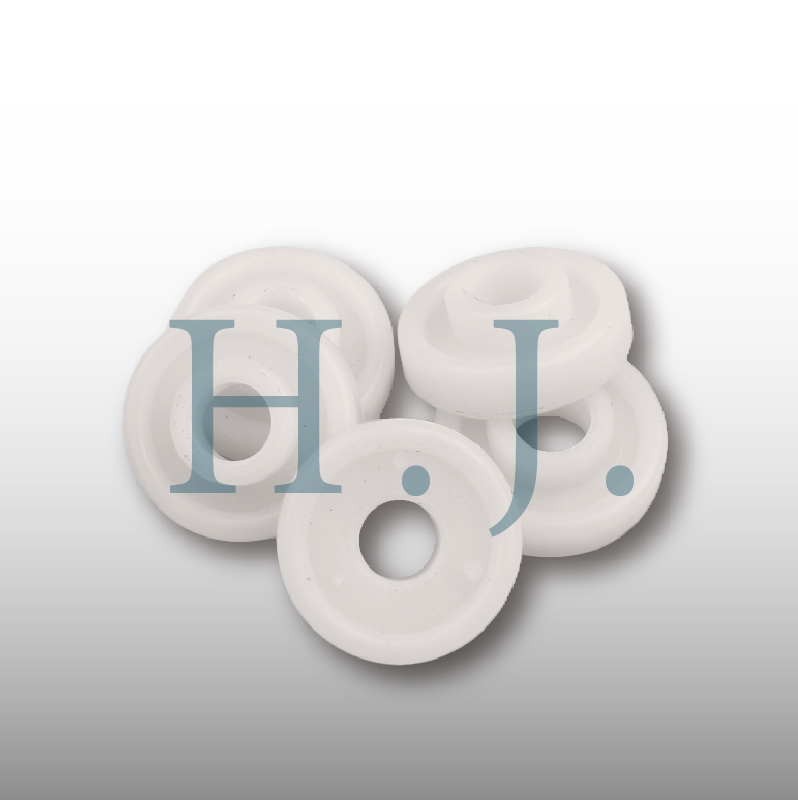
 Custom precision bearings
Custom Precision Bearings – Custom Bearing Manufacturer in Taiwan
Precision is an important consideration in bearing applications where dimensions, fit, movement, and repeatability can influence the performance of the complete mechanical system. Although standard bearings are suitable for many products, specialized equipment and OEM applications may require unique dimensions, configurations, or application-specific specifications. In these situations, custom precision bearings can provide a solution developed around the customer's actual requirements.
HSIAN JI BEARING CO., LTD. is a bearing manufacturer in Taiwan with experience in bearing development and production. Established in 1995, we manufacture various bearing products, including ball bearings, plastic bearings, thrust bearings, stamped bearings, slide bearings, special bearings, and non-standard bearings.
In addition to existing products, HSIAN JI can evaluate and develop bearings according to customer requirements and samples. For customers looking for custom precision bearings, our development process can begin with technical drawings, physical samples, dimensional requirements, applications, and production quantities.
What Are Custom Precision Bearings?
Custom precision bearings are bearing products developed according to customer-specific dimensional, structural, installation, and application requirements where consistent manufacturing and dimensional control are important.
Unlike standard catalogue products, customized bearings are evaluated around a particular mechanical application.
Customization may involve:
-
Inner diameter
-
Outer diameter
-
Bearing width
-
Overall dimensions
-
External configuration
-
Mounting dimensions
-
Housing requirements
-
Shaft compatibility
-
Material requirements
-
Application-specific features
-
Customer-defined inspection requirements
The objective of custom precision bearings is to provide a bearing solution that can be consistently integrated into the customer's product.
Why Are Precision Bearings Important?
Bearings interact directly with shafts, housings, rails, wheels, and other mechanical components.
If critical dimensions vary significantly, the bearing may not fit correctly or may influence the movement of the assembly.
Precision is therefore not limited to the bearing itself. It should be considered as part of the complete mechanical system.
For OEM manufacturers, dimensional consistency is particularly important because hundreds or thousands of products may need to use the same component.
A properly defined custom bearing specification can help establish clear requirements for development, production, and inspection.
When Are Custom Precision Bearings Required?
A customized bearing may be considered when standard catalogue products cannot adequately satisfy the application.
Typical situations include:
-
Special dimensions are required
-
Installation space is restricted
-
Shaft or housing dimensions are non-standard
-
A unique bearing configuration is needed
-
A new OEM product requires a dedicated component
-
A special bearing needs replacement
-
An obsolete component is no longer available
-
Repeat production requires consistent dimensions
-
A customer has a sample requiring reproduction
In these applications, working directly with a bearing manufacturer allows technical requirements to be evaluated before production.
Custom Precision Bearings Based on Engineering Drawings
Technical drawings are particularly important for precision components because they establish clear dimensional requirements.
A 2D engineering drawing can identify critical dimensions, geometry, and other specifications. Assembly drawings and 3D CAD models can provide additional information about how the bearing interacts with surrounding components.
Customers requesting custom precision bearings should provide as much information as possible, including:
-
2D technical drawings
-
3D CAD models
-
Critical dimensions
-
Shaft dimensions
-
Housing dimensions
-
Installation requirements
-
Application information
-
Operating conditions
-
Estimated quantities
-
Inspection requirements
-
Special specifications
Clearly defining critical characteristics at the beginning helps reduce uncertainty during product development.
Custom Precision Bearings from Physical Samples
In some projects, technical drawings are unavailable.
This is common when replacing components from older machinery, discontinued equipment, imported products, or specialized mechanical systems.
A physical bearing sample can provide an alternative starting point.
HSIAN JI can evaluate product development according to customer requirements and samples.
Customers should provide the original component together with available dimensions, application details, installation information, and required quantities.
For sample-based projects, additional technical confirmation may be necessary before mass production.
Custom Precision Ball Bearings
Ball bearings are widely used to reduce friction and provide smooth rotational movement.
Some OEM products require ball bearing dimensions or configurations that are not readily available as standard products.
Custom precision ball bearing requirements can be evaluated according to dimensions, shaft size, housing, installation space, movement, operating conditions, and other application requirements.
When dimensional consistency is particularly important, critical measurements should be clearly identified in the customer's drawing or specification.
Custom Precision Plastic Bearings
Plastic bearings may be used in applications where lightweight construction, corrosion resistance, low noise, or specific design characteristics are important.
HSIAN JI manufactures plastic bearing products and can evaluate customized dimensional and structural requirements.
For precision applications, the bearing should be evaluated according to dimensions as well as load, movement, temperature, moisture, and environmental conditions.
The appropriate design depends on the intended application.
Custom Precision Thrust Bearings
Thrust bearings are primarily designed to accommodate axial loads.
When standard thrust bearing dimensions or configurations cannot meet the mechanical requirements, customized development may be considered.
Customers should provide the required inner diameter, outer diameter, thickness, installation dimensions, axial load information, and operating conditions.
These requirements help the manufacturer evaluate an appropriate custom bearing solution.
Special and Non-Standard Precision Bearings
Custom precision bearing projects frequently involve special or non-standard products.
A non-standard bearing differs from commonly available catalogue dimensions or configurations. A special bearing may incorporate application-specific dimensions or structures.
These products may be required for:
-
Industrial machinery
-
Conveyor systems
-
Sliding mechanisms
-
Furniture hardware
-
Doors and windows
-
Medical equipment
-
Office equipment
-
Kitchen equipment
-
Fitness equipment
-
Sporting goods
-
Transportation products
-
Packaging equipment
-
Other OEM applications
HSIAN JI's experience with special and non-standard bearings provides a foundation for evaluating customized requirements beyond conventional catalogue products.
From Precision Bearing Design to Prototype
Developing custom precision bearings typically begins by establishing the customer's technical requirements.
Depending on project complexity, development may include:
-
Customer requirement analysis
-
Application evaluation
-
Drawing or sample review
-
Confirmation of critical dimensions
-
Design and manufacturing feasibility evaluation
-
Prototype or sample development
-
Dimensional inspection
-
Testing and verification
-
Trial production
-
Mass production
Prototype development can be especially useful for custom products because it allows dimensions and installation compatibility to be evaluated before volume manufacturing.
Dimensional Inspection and Quality Control
Quality control is a key part of precision bearing manufacturing.
For customized products, approved drawings, specifications, and samples can establish the requirements for production and inspection.
Depending on the product, quality management may include:
-
Incoming material inspection
-
Manufacturing process control
-
Dimensional measurement
-
In-process inspection
-
Product testing
-
Final inspection
-
Production monitoring
Clearly defined inspection criteria can help ensure that production parts remain consistent with the approved requirements.
For repeat OEM orders, maintaining this consistency is particularly important.
Custom Precision Bearings for OEM Manufacturing
OEM manufacturers often require components that can be produced consistently over multiple production batches.
A custom bearing may need to integrate with a shaft, housing, wheel, rail, or other component manufactured separately.
For this reason, dimensional requirements should be established with the complete assembly in mind.
Custom precision bearings can provide OEM manufacturers with greater flexibility when standard catalogue bearings cannot meet the required dimensions or mechanical configuration.
Clear technical documentation and quality criteria can also support repeat production and long-term sourcing.
Custom Precision Bearing Manufacturer in Taiwan
Taiwan has a mature manufacturing ecosystem covering machinery, precision components, hardware, metalworking, plastics, and OEM production.
For international buyers, working with a Taiwan bearing manufacturer can provide access to product development, manufacturing resources, technical communication, and established industrial supply chains.
HSIAN JI BEARING CO., LTD. has been involved in bearing development and manufacturing since 1995.
Our product portfolio includes ball bearings, plastic bearings, thrust bearings, stamped bearings, slide bearings, special bearings, and non-standard bearings.
If your application requires custom precision bearings, send us your technical drawings, samples, dimensions, application details, and estimated production quantities.
We can evaluate your requirements and discuss a suitable custom bearing solution.
Custom Precision Bearings FAQ
1. What are custom precision bearings?
Custom precision bearings are bearings developed according to specific customer requirements where dimensions, fit, configuration, and manufacturing consistency are important.
They may differ from standard catalogue bearings in size, structure, mounting configuration, or other application-specific characteristics.
The exact precision requirements should be defined according to the customer's application and technical specifications.
2. What makes a bearing a precision bearing?
In a general manufacturing context, a precision bearing requires controlled dimensions and consistent production according to defined specifications.
However, the required level of precision varies significantly between applications.
A bearing for one mechanical system may have different requirements from a bearing used in another product.
Customers should therefore clearly define critical dimensions and other requirements rather than relying only on the word "precision."
3. Can HSIAN JI manufacture custom precision bearings?
HSIAN JI can evaluate bearing development according to customer requirements, drawings, and samples.
Customized projects may involve special dimensions, non-standard configurations, or application-specific requirements.
Customers should provide technical specifications and identify important dimensions or inspection requirements so manufacturing feasibility can be evaluated.
4. What information should I provide for custom precision bearings?
Useful information includes:
-
2D engineering drawings
-
3D CAD models
-
Physical samples
-
Critical dimensions
-
Shaft dimensions
-
Housing dimensions
-
Installation requirements
-
Application information
-
Operating conditions
-
Estimated production quantity
-
Inspection requirements
-
Other special specifications
The more clearly the requirements are defined, the more effectively the project can be evaluated.
5. Can custom precision bearings be manufactured according to my drawing?
Customer drawings can provide the basis for evaluating a customized bearing.
For precision components, the drawing should clearly identify critical dimensions and other important specifications.
Customers should also provide application information and production quantities because manufacturing requirements can vary according to the intended use and production volume.
6. Can you develop precision bearings from physical samples?
HSIAN JI can evaluate product development according to customer requirements and physical samples.
This approach may be useful when replacing an existing special bearing for which technical documentation is unavailable.
However, a physical sample does not always provide every original engineering requirement.
Additional dimensional and application confirmation may therefore be necessary.
7. Can bearing dimensions be customized?
Special dimensional requirements can be evaluated according to the bearing design and manufacturing feasibility.
Customization may involve inner diameter, outer diameter, width, overall dimensions, mounting dimensions, or other critical measurements.
Because changing one dimension can influence other parts of the bearing, the complete configuration should be evaluated.
8. Can HSIAN JI manufacture custom precision ball bearings?
HSIAN JI manufactures ball bearing products and can evaluate customized requirements based on customer drawings, samples, and applications.
Customers should provide dimensions, shaft and housing information, operating conditions, and other technical requirements.
If particular dimensional or inspection requirements are important, they should be clearly identified during project evaluation.
9. Can plastic bearings be manufactured for precision applications?
HSIAN JI manufactures plastic bearing products and can evaluate customized requirements.
Whether a plastic bearing is appropriate depends on the application, dimensions, load, movement, temperature, environment, and required specifications.
The term "precision" should be supported by clearly defined dimensional and functional requirements for the particular application.
10. Can thrust bearings be customized for precision requirements?
Customized thrust bearing requirements can be evaluated according to the customer's specifications.
Important information may include inner diameter, outer diameter, thickness, installation dimensions, axial load conditions, operating environment, and critical dimensional requirements.
Providing a detailed drawing can help communicate these specifications accurately.
11. What is the difference between custom precision bearings and standard bearings?
Standard bearings are manufactured according to established dimensions and specifications for broad market applications.
Custom precision bearings are developed according to the requirements of a specific customer or mechanical system.
They may have unique dimensions, configurations, or customer-defined inspection requirements that are not available in standard catalogue products.
12. Are custom precision bearings also non-standard bearings?
They can be.
If a customized precision bearing has dimensions or configurations outside commonly available standard products, it can also be considered a non-standard bearing.
However, "precision" emphasizes dimensional and manufacturing requirements, while "non-standard" describes a product that differs from conventional catalogue specifications.
13. What industries use custom precision bearings?
Customized bearing solutions may be used in industrial machinery, conveyor equipment, furniture hardware, sliding systems, doors and windows, medical equipment, office equipment, fitness equipment, sporting goods, transportation products, packaging equipment, and other OEM applications.
The required specifications depend on the individual product and operating conditions.
14. Are custom precision bearings suitable for OEM production?
Yes. OEM manufacturing is an important application for customized bearings.
OEM products may have unique mechanical structures and require components that fit consistently across repeated production.
Clearly defined drawings, critical dimensions, approved samples, and inspection requirements can provide the technical foundation for stable production.
15. Can custom precision bearings replace discontinued bearings?
Potentially, depending on manufacturing feasibility.
Customers can provide an existing bearing sample together with available drawings, dimensions, application information, and production quantities.
The component can then be evaluated to determine whether a suitable replacement can be developed.
Additional technical confirmation may be required when original specifications are unavailable.
16. Can I get a prototype before ordering custom precision bearings in volume?
Depending on the project, sample or prototype development may be part of the process.
A prototype allows customers to evaluate dimensions, fit, installation compatibility, and other functional characteristics before proceeding to mass production.
This can be particularly useful for completely new or non-standard bearing designs.
17. How are custom precision bearings inspected?
Inspection requirements depend on the bearing and customer specifications.
Quality management may include dimensional measurement, process inspection, product testing, final inspection, and comparison with approved drawings or samples.
Customers should clearly identify critical dimensions and special inspection requirements when requesting a quotation.
18. What tolerance can you achieve on custom precision bearings?
Tolerance requirements should be evaluated individually according to the bearing design, dimensions, materials, manufacturing process, production quantity, and application.
Customers should specify the required tolerances on their technical drawings.
HSIAN JI can then evaluate whether those requirements are appropriate and feasible for the proposed product.
It is preferable to confirm actual tolerances during technical evaluation rather than assume a universal tolerance for every bearing.
19. Why source custom precision bearings from Taiwan?
Taiwan has an established manufacturing supply chain supporting precision components, machinery, metalworking, plastics, hardware, and OEM manufacturing.
For international buyers, a Taiwan manufacturer can provide access to product development and manufacturing resources.
When sourcing custom precision components, technical communication, dimensional control, quality management, and stable repeat production are important supplier-selection considerations.
20. Why choose HSIAN JI for custom precision bearings?
HSIAN JI BEARING CO., LTD. has been involved in bearing development and manufacturing in Taiwan since 1995.
Our product portfolio includes ball bearings, plastic bearings, thrust bearings, stamped bearings, slide bearings, special bearings, and non-standard bearings.
We can also evaluate products according to customer requirements and samples.
If you are looking for custom precision bearings for an OEM product, special mechanical application, non-standard design, or replacement component, provide HSIAN JI with your drawings, samples, critical dimensions, application information, inspection requirements, and estimated quantities.
We can evaluate your requirements and discuss an appropriate custom bearing solution.