
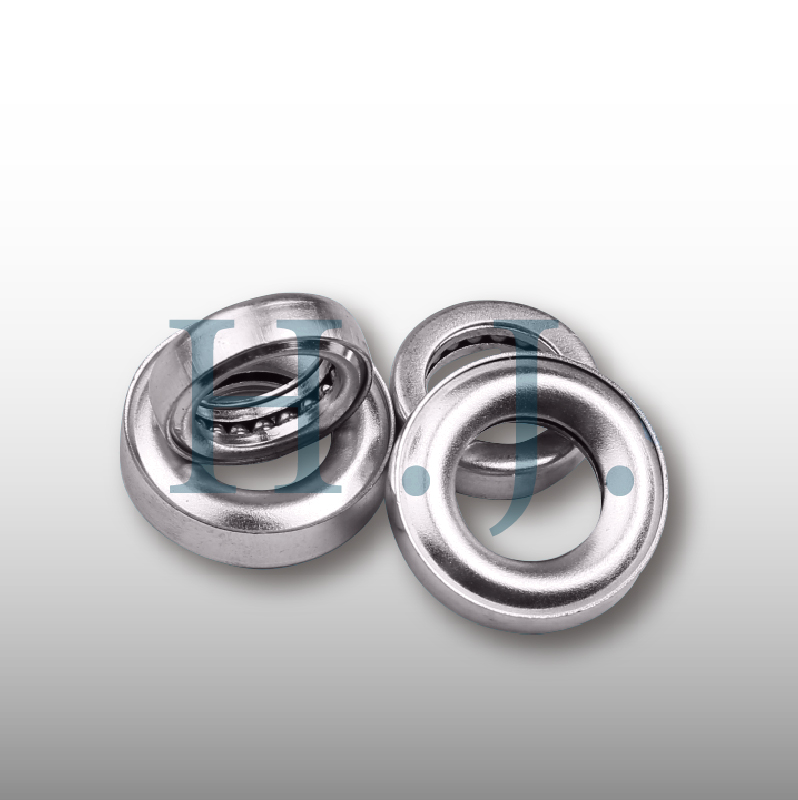
 Custom high temperature bearings
Custom High Temperature Bearings – High Temperature Bearing Manufacturer in Taiwan
Bearings used in elevated-temperature environments require different considerations from bearings operating under normal conditions. Heat can affect bearing materials, lubrication, dimensional stability, clearances, seals, cages, and surrounding components. When standard bearings cannot meet both the temperature and mechanical requirements of an application, custom high temperature bearings can provide an application-specific solution.
HSIAN JI BEARING CO., LTD. is a bearing manufacturer in Taiwan established in 1995. We manufacture various bearing products, including ball bearings, thrust bearings, plastic bearings, stamped bearings, slide bearings, special bearings, and non-standard bearings.
In addition to existing products, HSIAN JI can evaluate and develop bearing products according to different customer requirements and samples. For customers requiring custom high temperature bearings, we can evaluate projects according to operating temperature, dimensions, bearing configuration, materials, operating conditions, drawings, physical samples, and production requirements.
What Are Custom High Temperature Bearings?
Custom high temperature bearings are bearing solutions developed for applications involving elevated operating temperatures while also meeting customer-specific dimensional, structural, material, or installation requirements.
Temperature is only one part of the specification.
A bearing designed for a high-temperature application may also need to consider:
- Inner and outer dimensions
- Bearing width
- Load conditions
- Operating speed
- Bearing materials
- Cage materials
- Lubrication requirements
- Internal clearance
- Thermal expansion
- Installation conditions
- Environmental exposure
- Maintenance requirements
For this reason, custom high temperature bearings should be developed according to the complete operating environment rather than temperature alone.
Why Does Temperature Matter in Bearing Design?
Temperature can influence several parts of a bearing system.
Metal components expand as temperature increases. Lubricants may also behave differently at elevated temperatures. Plastic, rubber, seals, cages, and other materials can have specific temperature limitations.
The surrounding shaft and housing can also experience thermal expansion.
As a result, engineers should consider the complete assembly when selecting or developing a high-temperature bearing.
Important information includes both normal operating temperature and possible maximum temperature.
For applications involving heating and cooling cycles, the frequency and duration of temperature changes should also be communicated.
When Are Custom High Temperature Bearings Required?
Standard bearings may be appropriate if their dimensions, materials, lubrication, and temperature capabilities satisfy the application.
Customized development may be considered when:
- Standard bearings cannot tolerate the required operating environment
- Special bearing dimensions are required
- Installation space is limited
- A unique bearing configuration is needed
- Standard lubrication is unsuitable
- Thermal expansion must be considered
- A special material is required
- An existing high-temperature bearing is discontinued
- An OEM machine requires a dedicated bearing
- A non-standard sample needs to be reproduced
The appropriate solution depends on the combination of temperature and mechanical requirements.
Materials for High Temperature Bearings
Material selection is one of the most important considerations in high-temperature bearing applications.
Different materials have different thermal, mechanical, wear, and corrosion characteristics.
Depending on the bearing design, material selection may need to consider the rings, rolling elements, cages, washers, housings, or other components.
Customers should provide detailed information about:
- Continuous operating temperature
- Maximum temperature
- Heating duration
- Heating and cooling cycles
- Load
- Speed
- Humidity
- Chemical exposure
- Dust or contamination
- Required service environment
If a particular material is already specified by the customer's engineering department, it should be identified in the technical drawing or inquiry.
Lubrication and High Temperature Operation
Lubrication is another important factor when evaluating bearings for elevated temperatures.
Conventional lubricants may not be suitable for every temperature range. Lubricant characteristics can change as operating temperatures increase.
The appropriate lubrication strategy depends on bearing type, temperature, speed, load, operating duration, maintenance requirements, and environmental conditions.
For this reason, customers requesting custom high temperature bearings should provide accurate operating-temperature information instead of simply describing the application as "high temperature."
This helps establish a more meaningful basis for technical evaluation.
Thermal Expansion and Bearing Clearance
Heat causes materials to expand.
In a bearing assembly, the bearing, shaft, housing, and surrounding components may expand differently depending on their materials and temperatures.
This can potentially affect fit and operating clearance.
For customized applications, engineers should therefore consider the relationship between:
- Bearing dimensions
- Shaft dimensions
- Housing dimensions
- Material properties
- Temperature changes
- Installation method
- Required operating conditions
An assembly drawing can provide valuable information when evaluating these relationships.
Custom Size High Temperature Bearings
High-temperature requirements are sometimes combined with non-standard dimensional requirements.
A customer may require a special inner diameter, outer diameter, width, or overall bearing configuration that is unavailable from standard catalogues.
Customized dimensions may include:
- Inner diameter
- Outer diameter
- Bearing width
- Overall thickness
- Flange dimensions
- Washer dimensions
- Mounting dimensions
- Special external geometry
HSIAN JI can evaluate special and non-standard bearing requirements according to customer specifications and manufacturing feasibility.
Custom High Temperature Bearings Based on Drawings
Engineering drawings are one of the most effective ways to communicate customized bearing requirements.
Customers can provide:
- 2D technical drawings
- 3D CAD models
- Assembly drawings
- Bearing dimensions
- Shaft dimensions
- Housing dimensions
- Material requirements
- Operating temperature
- Load conditions
- Speed
- Installation requirements
- Estimated quantities
The more complete the information, the more effectively the manufacturer can evaluate the proposed bearing.
Custom High Temperature Bearings from Samples
In some cases, a customer needs to replace an existing high-temperature bearing but no longer has the original engineering drawing.
This can occur with older industrial machinery, imported equipment, discontinued components, or specialized OEM machines.
HSIAN JI can develop and manufacture samples according to different customer requirements.
An existing bearing sample can therefore provide a useful starting point for evaluation.
Customers should also provide operating-temperature information and application details because a physical sample alone may not reveal all original material, lubrication, clearance, or performance specifications.
High Temperature Ball Bearing Applications
Ball bearings are used in many rotational applications.
When ball bearings operate at elevated temperatures, factors such as materials, lubrication, clearance, speed, load, and dimensional stability should be evaluated.
A custom high temperature bearing may be considered when standard ball bearing products cannot meet both the mechanical and environmental requirements.
HSIAN JI lists ball bearings among its principal bearing categories.
For custom projects, customers should provide drawings and actual operating conditions for evaluation.
High Temperature Thrust Bearing Applications
Thrust bearings primarily support axial loads.
When thrust bearings are used in elevated-temperature environments, both axial loading and temperature must be considered.
Customers should provide information such as:
- Inner diameter
- Outer diameter
- Thickness
- Axial load
- Operating speed
- Continuous temperature
- Maximum temperature
- Installation conditions
HSIAN JI manufactures thrust bearings and can evaluate customized requirements according to the application.
High Temperature Plastic Bearing Considerations
Some engineering plastics can operate at elevated temperatures, while others have significantly lower temperature limits.
Therefore, a plastic bearing should never be assumed to be suitable for high-temperature operation simply because it is made from an engineering plastic.
Material selection depends on temperature, load, speed, wear requirements, chemical exposure, and mechanical design.
HSIAN JI manufactures plastic bearing products, allowing customized plastic-bearing requirements to be evaluated according to customer applications.
Applications for Custom High Temperature Bearings
Depending on their specifications, customized high-temperature bearing solutions may be considered for equipment such as:
- Industrial machinery
- Drying equipment
- Heating equipment
- Conveyors
- Ovens and furnace-related equipment
- Packaging machinery
- Processing equipment
- Production lines
- Specialized rollers
- High-temperature mechanical assemblies
- Other OEM equipment
The bearing requirements can differ significantly between applications, even when operating temperatures appear similar.
From Bearing Design to Production
HSIAN JI's website describes its development process as including concept and product design, material selection, prototyping, testing and verification, production preparation, trial production, and mass production.
For a custom high-temperature project, a typical development process may therefore involve:
- Reviewing application requirements
- Confirming operating temperatures
- Reviewing drawings or samples
- Evaluating dimensions and configuration
- Evaluating material requirements
- Reviewing manufacturing feasibility
- Prototype or sample development
- Testing and verification
- Trial production
- Mass production
Testing under representative operating conditions is particularly important when temperature significantly affects bearing performance.
Quality Control for Custom Bearings
Quality control should continue throughout the manufacturing process.
HSIAN JI states that its quality assurance activities include raw-material control, manufacturing-process control, finished-product inspection and testing, quality management, and continuous improvement.
For customized high-temperature products, approved drawings, specifications, samples, and agreed testing requirements can provide the basis for manufacturing and inspection.
Custom High Temperature Bearing Manufacturer in Taiwan
HSIAN JI BEARING CO., LTD. has manufactured bearing products in Taiwan since 1995 and supports development according to different customer needs and samples.
If standard bearings cannot meet your dimensional and temperature requirements, provide us with your drawings, samples, operating temperatures, dimensions, load information, speed, environment, and estimated production quantities.
HSIAN JI can evaluate your custom high temperature bearings project and discuss a suitable bearing solution for your industrial or OEM application.
Custom High Temperature Bearings FAQ
1. What are custom high temperature bearings?
Custom high temperature bearings are bearing solutions developed for elevated-temperature applications according to customer-specific requirements.
Customization may involve dimensions, materials, bearing configuration, lubrication requirements, clearance, mounting, or other application-specific characteristics.
The actual design should be evaluated according to both temperature and mechanical operating conditions.
2. What temperature is considered high temperature for a bearing?
There is no single temperature that defines every high-temperature bearing application.
The significance of temperature depends on the bearing materials, lubrication, seals, cages, load, speed, and surrounding components.
Customers should specify actual continuous and maximum operating temperatures when requesting a customized bearing.
3. What is the maximum temperature of your high temperature bearings?
Maximum operating temperature depends on the specific bearing design, materials, lubrication, load, speed, and environment.
Therefore, HSIAN JI should evaluate the customer's actual application before confirming temperature capability.
For an accurate evaluation, provide both continuous operating temperature and maximum temperature.
4. Can HSIAN JI manufacture custom high temperature bearings?
HSIAN JI manufactures several bearing categories and develops and manufactures products according to different customer requirements and samples.
High-temperature requirements can therefore be submitted for technical and manufacturing feasibility evaluation.
Customers should provide complete operating information rather than temperature alone.
5. What information should I provide?
For custom high temperature bearings, useful information includes:
- Technical drawings
- Physical samples
- Inner and outer dimensions
- Bearing width
- Continuous operating temperature
- Maximum temperature
- Load
- Speed
- Operating cycle
- Shaft and housing dimensions
- Environment
- Material requirements
- Estimated quantity
Complete specifications help provide a better basis for technical evaluation.
6. Why is continuous operating temperature important?
A bearing exposed continuously to elevated temperature may have different requirements from one exposed to heat for only a short period.
Continuous temperature can influence materials, lubrication, thermal expansion, and other aspects of bearing operation.
Customers should therefore distinguish between normal operating temperature and short-term maximum temperature.
7. Does thermal cycling affect bearings?
Repeated heating and cooling can cause bearing and surrounding components to expand and contract.
The effects depend on materials, temperature range, fit, bearing configuration, and mechanical design.
If the application experiences frequent thermal cycling, this information should be included in the project specifications.
8. Can high temperature bearing dimensions be customized?
Special dimensional requirements can be evaluated.
Customers may require custom inner diameter, outer diameter, width, thickness, flange dimensions, or other non-standard measurements.
HSIAN JI includes special and non-standard bearings among its product categories.
9. Can you manufacture a high temperature bearing from my drawing?
Customer drawings can provide an important basis for evaluating customized products.
Drawings should identify dimensions, materials, and other critical requirements.
For high-temperature applications, customers should additionally provide operating temperature, load, speed, environment, and installation information.
10. Can you reproduce an existing high temperature bearing from a sample?
HSIAN JI states that it can develop and manufacture samples according to different customer needs.
An existing bearing can therefore provide useful information for evaluation.
However, customers should also provide operating conditions because the sample itself may not reveal its original temperature rating, lubricant, material specification, or internal design requirements.
11. What materials are used for high temperature bearings?
Material selection depends on the application.
Different metals, engineering plastics, cages, and other components have different thermal characteristics.
The correct material should be evaluated according to operating temperature, load, speed, environment, wear requirements, and bearing design.
If a specific material is required, customers should identify it on their drawing.
12. Do high temperature bearings require special lubrication?
Some high-temperature applications may require lubrication specifically selected for elevated operating temperatures.
Lubricant selection depends on temperature, bearing type, load, speed, operating duration, and maintenance requirements.
Customers should provide accurate operating conditions when requesting a bearing solution.
13. Can high temperature bearings operate without lubrication?
This depends on the bearing design, materials, operating temperature, speed, load, and application.
It should not be assumed that all high-temperature bearings are lubrication-free.
If a customer requires dry operation or cannot use conventional lubrication, this should be specified during the design evaluation.
14. Can ball bearings be customized for high temperatures?
HSIAN JI manufactures ball bearings, and customized requirements can be evaluated according to customer needs.
For elevated-temperature applications, dimensions, materials, lubrication, load, speed, clearance, and operating environment should be considered together.
15. Can thrust bearings be customized for high temperatures?
HSIAN JI also manufactures thrust bearings.
Custom high-temperature thrust bearing requirements can be evaluated according to dimensions, axial-load conditions, temperature, speed, materials, installation, and other specifications.
16. Can plastic bearings operate at high temperatures?
Some engineering plastics have greater heat resistance than others, but temperature capability varies considerably by material.
Plastic bearing suitability should therefore be evaluated according to material, continuous temperature, peak temperature, load, speed, and environmental conditions.
Customers should provide actual operating temperatures for evaluation.
17. Are custom high temperature bearings also non-standard bearings?
They can be.
When a high-temperature bearing has dimensions, materials, structures, or configurations that differ from commonly available catalogue products, it may also be classified as a non-standard bearing.
HSIAN JI manufactures both special and non-standard bearing products.
18. Can I get a prototype before mass production?
HSIAN JI's published product-development process includes prototyping, testing and verification, production preparation, trial production, and mass production.
For a custom high-temperature bearing project, prototype testing can be particularly valuable because the bearing may need to be evaluated under representative temperature and operating conditions.
19. How are custom high temperature bearings quality controlled?
HSIAN JI describes its quality assurance process as including raw-material control, manufacturing-process control, finished-product inspection and testing, quality management, and continuous improvement.
For custom products, approved drawings and agreed specifications can provide additional references for inspection and production.
20. Why choose HSIAN JI for custom high temperature bearings?
HSIAN JI BEARING CO., LTD. was established in Taiwan in 1995 and manufactures multiple bearing categories, including ball, thrust, plastic, stamped, slide, special, and non-standard bearings. The company also states that it can develop and manufacture products according to different customer needs and samples.
If you require custom high temperature bearings for industrial machinery, an OEM product, specialized equipment, a non-standard application, or replacement of an existing bearing, provide HSIAN JI with your drawings, samples, operating temperature, load, speed, dimensions, environment, and estimated quantity.
These details can be used to evaluate an appropriate customized high-temperature bearing solution.