
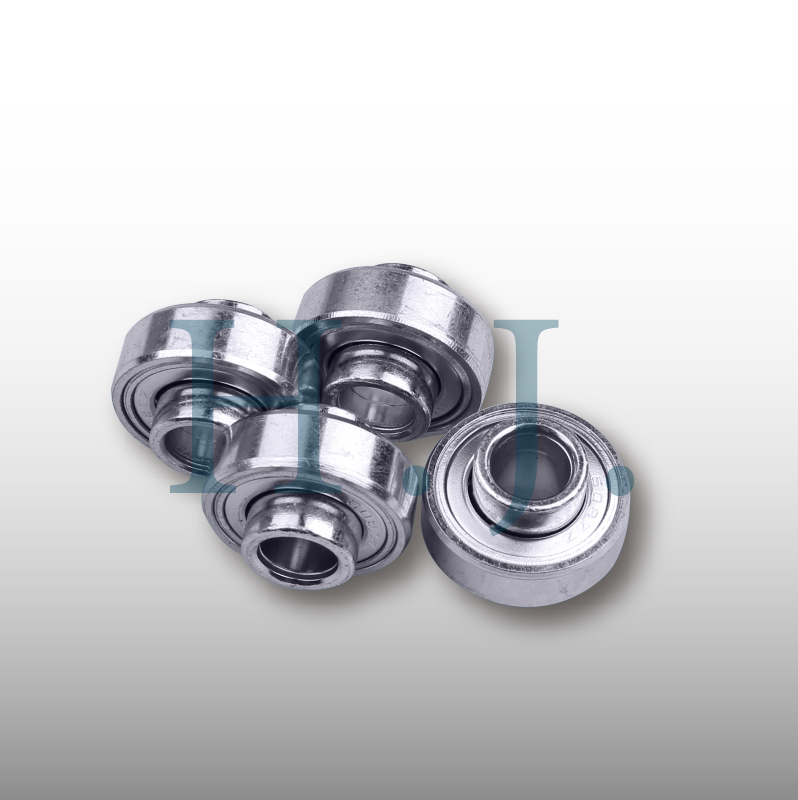
 Modified standard bearings
Modified Standard Bearings – Customized Bearing Solutions Based on Standard Designs
Standard bearings are widely used because they are readily available, familiar to engineers, and suitable for many mechanical applications. However, a standard bearing does not always fit perfectly into every product or machine. In some cases, the basic bearing design is suitable, but certain dimensions, mounting features, materials, or external structures need to be adjusted. In these situations, modified standard bearings can provide a practical solution.
Modified standard bearings are based on an existing or conventional bearing concept but are adapted to better match a specific mechanical application. This approach can sometimes provide a more efficient alternative to developing a completely new bearing design from the beginning.
HSIAN JI BEARING CO., LTD. is a bearing manufacturer based in Taiwan. Established in 1995, HSIAN JI manufactures ball bearings, plastic bearings, thrust bearings, stamped bearings, slide bearings, special bearings, and non-standard bearings.
For customers requiring modified standard bearings, HSIAN JI can evaluate requirements according to technical drawings, physical samples, dimensions, applications, materials, and production quantities.
What Are Modified Standard Bearings?
Modified standard bearings are bearings that begin with an existing standard or conventional bearing configuration and are then changed to meet specific customer requirements.
The modification may involve:
- Inner diameter
- Outer diameter
- Width
- Flange dimensions
- Mounting features
- External geometry
- Material
- Housing relationship
- Shaft relationship
- Application-specific details
The objective is to retain a proven basic bearing concept while modifying the characteristics that prevent the standard product from fitting the application.
Why Modify a Standard Bearing?
A standard bearing may be very close to what a customer needs but still have one or more unsuitable characteristics.
For example:
- The bore diameter may be slightly different from the shaft
- The outside diameter may not fit the housing
- The width may be too large
- A flange may be required
- The external structure may interfere with another component
- A different material may be preferred
- A unique mounting feature may be necessary
Rather than redesigning the entire machine or creating a completely new bearing structure, modifying an existing bearing concept can sometimes provide a practical engineering approach.
Modified Standard Bearings vs. Custom Bearings
Modified standard bearings and custom bearings are related but not exactly the same.
A custom bearing may be designed extensively around a specific application and may differ significantly from standard products.
A modified standard bearing starts from an existing bearing design and changes only the characteristics required for the application.
This distinction can be useful during project evaluation.
If only a few dimensions or features need to change, modification may be sufficient. If the entire bearing structure is unsuitable, a more fully customized or non-standard solution may be necessary.
Modified Standard Ball Bearings
Ball bearings are commonly used in rotational applications.
A standard ball bearing may provide the required basic function but not the exact dimensions needed by the product.
Possible modifications can involve:
- Bore diameter
- Outside diameter
- Width
- External configuration
- Mounting arrangement
- Integration with surrounding components
Customers should provide complete shaft and housing dimensions together with load, speed, environment, and quantity information.
HSIAN JI manufactures ball bearing products and can evaluate customized requirements.
Modified Standard Plastic Bearings
Plastic bearings can provide useful characteristics such as lightweight construction, corrosion resistance, reduced noise, and design flexibility.
A standard plastic bearing may be modified according to:
- Dimensions
- Material
- Mounting
- External geometry
- Application requirements
Customers should provide information about load, speed, temperature, moisture, chemicals, movement, and operating environment.
The bearing material and dimensions should be evaluated together.
Modified Standard Thrust Bearings
Thrust bearings are primarily designed to support axial loads.
A standard thrust bearing may need dimensional modification when the customer's shaft or installation space differs from conventional sizes.
Possible changes can include:
- Inner diameter
- Outer diameter
- Thickness
- Washer dimensions
- Mounting arrangement
Customers should provide axial load, operating speed, materials, and assembly information for evaluation.
Modified Standard Slide Bearings
Slide bearings are used for sliding or guided movement.
A standard slide bearing may need to be adapted to fit a particular:
- Rail
- Guide
- Frame
- Bracket
- Housing
- Sliding mechanism
HSIAN JI has a dedicated slide-bearing product category.
Assembly drawings can be particularly useful because they show how the bearing interacts with the complete movement system.
Modified Standard Stamped Bearings
Stamped bearings can provide practical solutions for mechanical, hardware, furniture, and equipment applications.
Modification may involve:
- Stamped dimensions
- External geometry
- Metal structure
- Mounting features
- Application-specific configuration
HSIAN JI includes stamped bearings among its product categories.
Customers can provide drawings or samples for evaluation.
Modified Standard Bearings with Custom Dimensions
Dimensions are one of the most common reasons for modifying a standard bearing.
A customer may require a different:
- Inner diameter
- Outer diameter
- Width
- Thickness
- Flange size
- Mounting dimension
For example, an existing product may have a fixed shaft and housing that cannot be redesigned.
If a standard bearing is close to the required dimensions, modifying selected dimensions may be evaluated.
Modified Bearings Based on Engineering Drawings
Engineering drawings provide a clear basis for bearing modification.
Customers should provide:
- Existing bearing dimensions
- Required new dimensions
- Material requirements
- Critical tolerances
- Mounting requirements
- Application information
A 2D technical drawing can show exactly which dimensions need to change.
A 3D CAD model or assembly drawing can provide additional information about the surrounding mechanical structure.
Modified Bearings from Physical Samples
Some customers have an existing bearing but no engineering drawing.
A physical sample can provide useful dimensional and structural information.
This is particularly relevant to:
- Older machinery
- Imported equipment
- Existing OEM products
- Difficult-to-source components
- Discontinued parts
HSIAN JI states that it can develop, produce, and manufacture products according to different customer needs.
Customers should also provide application information because not all original specifications can be determined from the sample alone.
Modified Bearings for OEM Applications
OEM manufacturers often require components that are based on standard mechanical concepts but customized to fit their finished products.
A modified standard bearing can help OEM designers optimize:
- Product dimensions
- Assembly layout
- Mounting
- Component integration
- Mechanical movement
OEM customers should provide:
- Engineering drawings
- Assembly drawings
- Required modifications
- Material specifications
- Initial quantities
- Estimated annual demand
- Quality requirements
This information helps evaluate both technical and production feasibility.
Prototype Modified Standard Bearings
Prototype development can help verify whether the proposed modification works before regular production.
A prototype can be checked for:
- Dimensions
- Fit
- Installation
- Movement
- Assembly compatibility
- Mechanical interaction
HSIAN JI's product-development process includes concept-to-product development, prototyping, testing, and production.
If the modified bearing does not fit correctly, changes can be evaluated before production preparation.
Testing and Verification
Testing is especially useful when a standard bearing has been modified in a way that affects its interaction with surrounding components.
Evaluation can include:
- Dimensional inspection
- Installation checking
- Fit verification
- Movement evaluation
- Customer-defined testing
The exact testing method depends on the application.
Trial Production and Mass Production
After a modified design is approved, trial production can help determine whether the bearing can be manufactured consistently.
This stage can help verify:
- Manufacturing procedures
- Dimensional consistency
- Process stability
- Inspection methods
- Assembly
- Production efficiency
Once the process is confirmed, recurring production can proceed according to agreed specifications.
Quality Control for Modified Standard Bearings
Quality control is important because every modification creates customer-specific requirements.
HSIAN JI describes its production and quality-assurance process as covering raw-material procurement, manufacturing-process control, final-product inspection and testing, and continuous improvement.
For modified bearings, approved drawings and specifications can provide important references for manufacturing.
Modified Standard vs. Non-Standard Bearings
The categories can overlap.
A modified standard bearing generally begins with a conventional bearing concept and changes selected features.
A non-standard bearing is a broader category that may differ significantly from catalogue products in dimensions, structure, or configuration.
HSIAN JI maintains a dedicated non-standard bearing range used across machinery, conveyors, medical equipment, office equipment, hardware, packaging, furniture, transportation products, scooters, skates, and related applications.
Replacement Modified Bearings
A replacement project may involve a bearing that is very similar to a standard product but has one or two special characteristics.
Examples include:
- Special width
- Modified bore
- Special outside diameter
- Added flange
- Unique mounting feature
In these cases, modifying a standard-type product may be worth evaluating.
Customers should provide the original bearing, available drawings, shaft and housing dimensions, and application information.
Low Volume Modified Standard Bearings
Some projects require relatively small quantities.
These can include:
- Product prototypes
- Replacement components
- Specialized machinery
- Initial OEM production
- Product testing
Feasibility depends on the modification, materials, tooling, process, and quantity.
Customers should provide initial demand and estimated future requirements.
Applications for Modified Standard Bearings
Depending on bearing type and modification, these products can be considered for:
- Industrial machinery
- Conveyors
- Packaging equipment
- Medical equipment
- Office equipment
- Furniture
- Sliding systems
- Hardware products
- Transportation products
- Bicycles
- Scooters
- Skates
- OEM mechanical assemblies
HSIAN JI's existing non-standard bearing range covers many of these application categories.
Why Choose Modified Standard Bearings?
Modified standard bearings can be useful when the standard bearing concept is fundamentally suitable but requires selected changes.
Potential advantages include:
- Maintaining a familiar bearing structure
- Adapting the bearing to existing equipment
- Avoiding unnecessary redesign of surrounding components
- Supporting OEM-specific requirements
- Providing a practical bridge between standard and fully custom products
The best approach depends on the complete application and manufacturing feasibility.
HSIAN JI – Modified Standard Bearings from Taiwan
HSIAN JI BEARING CO., LTD. has manufactured bearing products in Taiwan since 1995. Its product portfolio includes plastic, thrust, stamped, slide, ball, special, and non-standard bearings, supported by dedicated design/product-development and production/quality-assurance functions.
For modified standard bearings, customers can provide:
- Existing bearing model
- Engineering drawing
- Physical sample
- Required dimensional changes
- Material requirements
- Load and speed information
- Application
- Operating environment
- Initial quantity
- Estimated annual demand
HSIAN JI can evaluate whether modification, special bearing development, or a non-standard bearing solution is most appropriate for the application.
Modified Standard Bearings FAQ
What are modified standard bearings?
Modified standard bearings are bearings based on conventional bearing designs but changed according to specific customer requirements.
The modification may involve dimensions, materials, mounting features, external geometry, or other application-specific characteristics.
How are modified standard bearings different from custom bearings?
A modified standard bearing begins with an existing standard-type bearing concept and changes selected features.
A fully custom bearing may require a more extensive redesign.
The appropriate approach depends on how much the standard bearing needs to change.
When should I modify a standard bearing?
Modification may be worth considering when a standard bearing is close to the required specification but does not fit because of dimensions, mounting, material, or surrounding components.
Does HSIAN JI provide modified bearing solutions?
HSIAN JI develops and manufactures multiple bearing categories and supports customer-specific development, special bearings, and non-standard bearings.
Modified requirements can therefore be submitted for evaluation.
Can the inner diameter of a standard bearing be modified?
Special bore requirements can be evaluated according to the bearing structure and manufacturing feasibility.
Customers should provide complete shaft, housing, width, load, and application information.
Can the outer diameter be modified?
A custom outside diameter can be evaluated when the bearing needs to fit a specific housing or surrounding component.
Changing the outside diameter may influence the overall bearing structure, so complete drawings are recommended.
Can bearing width be modified?
Special-width requirements can be evaluated.
The effect on internal structure, assembly, and manufacturability should also be considered.
Can a flange be added or modified?
Depending on the bearing design, special flange requirements may be evaluated.
Customers should provide complete flange and mounting dimensions.
Can bearing materials be changed?
Material changes can be evaluated according to bearing type and application.
Customers should explain the reason for the material change and provide operating conditions such as temperature, moisture, chemicals, load, and speed.
Can you modify ball bearings?
HSIAN JI manufactures ball bearing products.
Requirements involving special dimensions or external configurations can be submitted for evaluation.
Can you modify plastic bearings?
Plastic bearings are one of HSIAN JI's product categories.
Custom dimensions, material requirements, and application-specific features can be evaluated according to the project.
Can you modify thrust bearings?
Thrust bearing requirements can be evaluated according to dimensions, axial load, speed, materials, and installation conditions.
Can slide bearings be modified?
HSIAN JI manufactures slide bearings.
Requirements involving dimensions, rails, guides, mounting structures, and other features can be evaluated.
Can stamped bearings be modified?
Stamped bearing projects can be evaluated according to customer drawings, geometry, dimensions, materials, and production quantities.
Can modified standard bearings be based on my drawing?
Yes. Engineering drawings are one of the most useful references for showing exactly which standard bearing features need to change.
Customers should clearly mark existing and required dimensions.
Can you work from a physical sample?
A physical sample can provide a useful starting point when drawings are unavailable.
However, additional operating and technical information should also be provided.
Can you modify a bearing for a special shaft size?
Potentially.
Customers should provide shaft diameter, housing dimensions, bearing width, load, speed, and other assembly information for evaluation.
Can modified bearings solve installation-space problems?
They may help when a standard bearing is close to the required dimensions but is too wide, too large, or has unsuitable mounting geometry.
The complete assembly should be reviewed.
Can modified standard bearings be used for OEM applications?
Yes. OEM products frequently require small changes to otherwise conventional bearing designs.
Customers should provide drawings, quantities, annual demand, and application requirements.
Can modified standard bearings replace obsolete bearings?
Potentially.
An obsolete bearing may be similar to a current standard product but differ in one or more dimensions or features.
The original sample and application should be evaluated.
Can modified bearings replace hard-to-find bearings?
A hard-to-find bearing may be a candidate for modification or custom development.
Customers should provide the original bearing or complete technical specifications.
Can I request a prototype before production?
Depending on the project, a prototype can help verify that the modification fits and functions correctly.
HSIAN JI includes prototyping and testing within its published development process.
Can the modification be changed after prototype testing?
If the prototype identifies installation or dimensional issues, further modifications can be evaluated before production preparation.
Can modified bearings be produced in low quantities?
Lower-volume projects can be submitted for evaluation.
Feasibility depends on the type of modification, tooling, materials, manufacturing process, and quantity.
Can modified standard bearings be mass produced?
After the modified design and manufacturing process are approved, recurring production can be evaluated according to customer requirements.
Are modified standard bearings cheaper than fully custom bearings?
Not necessarily.
Cost depends on bearing design, modifications, materials, tooling, quantity, inspection requirements, and manufacturing processes.
In some projects, modification may be simpler than developing an entirely new design, but pricing should be evaluated case by case.
How do you determine whether to modify a standard bearing or create a non-standard bearing?
The decision depends on how closely an existing bearing matches the application.
If only limited characteristics need to change, modification may be appropriate.
If dimensions or structure differ substantially, a non-standard or fully customized bearing may be more suitable.
What information should I provide for a quotation?
For a modified standard bearings inquiry, provide:
- Existing bearing model, if known
- 2D technical drawing
- 3D CAD model
- Physical sample
- Existing dimensions
- Required new dimensions
- Materials
- Required tolerances
- Load
- Speed
- Application
- Operating environment
- Initial quantity
- Estimated annual demand
This information helps determine the most appropriate manufacturing approach.
What applications use modified standard bearings?
Modified standard bearings can be relevant to machinery, conveyors, furniture, packaging equipment, medical equipment, office equipment, sliding systems, hardware, transportation products, and specialized OEM products.
The suitability of modification depends on the actual application.
Why choose HSIAN JI for modified standard bearings?
HSIAN JI BEARING CO., LTD. has manufactured bearing products in Taiwan since 1995 and provides ball, plastic, thrust, stamped, slide, special, and non-standard bearing categories. The company also maintains design/product-development and production/quality-assurance capabilities.
If a standard bearing is close to your requirements but needs changes in dimensions, material, mounting, or geometry, send HSIAN JI your drawing, sample, existing bearing model, application details, and production quantities for evaluation.