
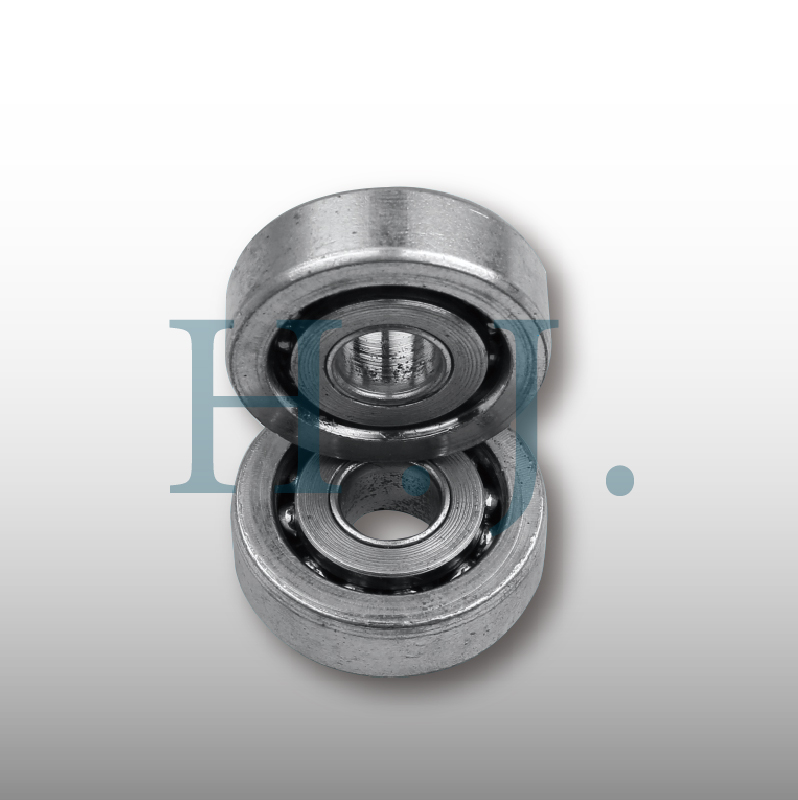
 Non standard bearings
Non Standard Bearings – Custom Bearing Solutions from Taiwan
Standard bearings are widely available in established sizes and configurations, but not every machine, product, or mechanical assembly can use a standard bearing. Special shaft dimensions, restricted installation space, unique mounting structures, discontinued components, or original equipment designs can create the need for non standard bearings.
Non standard bearings are developed to meet application requirements that cannot be satisfied by conventional catalogue products. They may feature customized dimensions, special external structures, unique mounting arrangements, different materials, or other application-specific characteristics.
HSIAN JI BEARING CO., LTD. is a bearing manufacturer based in Taiwan. Established in 1995, we develop and manufacture bearing products for a wide range of mechanical applications. Our product categories include ball bearings, plastic bearings, thrust bearings, stamped bearings, slide bearings, special bearings, and non-standard bearings.
For customers requiring non standard bearings, HSIAN JI can evaluate projects according to engineering drawings, physical samples, dimensions, materials, application requirements, and production quantities.
What Are Non Standard Bearings?
Non standard bearings are bearing products that differ from conventional catalogue sizes, structures, or specifications.
A standard bearing is normally manufactured according to established dimensions and can be selected using a catalogue number.
A non-standard bearing is generally required when the application has unique requirements.
These can include:
-
Special inner diameter
-
Special outer diameter
-
Custom width
-
Unique overall dimensions
-
Special flange dimensions
-
Unusual external geometry
-
Custom mounting features
-
Limited installation space
-
Special material requirements
-
Application-specific structures
The exact design depends on the customer's mechanical system and operating requirements.
Why Are Non Standard Bearings Needed?
Machines and products are not always designed around standard bearing dimensions.
In some applications, engineers have limited space available and cannot modify the shaft, housing, frame, rail, or surrounding components.
In other situations, an existing machine may use a bearing that is no longer readily available.
Non standard bearings can provide a solution for applications involving:
-
Custom machinery
-
OEM equipment
-
Existing mechanical assemblies
-
Special product designs
-
Restricted installation spaces
-
Older machines
-
Imported equipment
-
Discontinued bearing models
Instead of redesigning an entire mechanical system, developing a bearing according to the required dimensions may provide a practical alternative.
Non Standard Ball Bearings
Standard ball bearings are available in many sizes, but customized applications may require dimensions or structures that do not correspond to conventional catalogue models.
Non-standard ball-bearing requirements may involve:
-
Custom bore diameter
-
Custom outer diameter
-
Special width
-
Different external structure
-
Unique mounting configuration
-
Application-specific dimensions
Customers should provide shaft dimensions, housing dimensions, load, speed, installation information, and operating conditions when requesting development.
HSIAN JI manufactures ball bearing products and can evaluate customized requirements according to manufacturing feasibility.
Non Standard Plastic Bearings
Plastic bearings can provide useful characteristics for specialized mechanical applications.
Depending on material and design, potential advantages can include:
-
Lightweight construction
-
Corrosion resistance
-
Reduced noise
-
Moisture resistance
-
Design flexibility
A non-standard plastic bearing can also be developed around unique dimensions or mechanical structures.
Customers should provide information about temperature, load, movement, moisture, chemicals, and environmental conditions so that material and design requirements can be properly evaluated.
Non Standard Thrust Bearings
Thrust bearings are primarily designed to support axial loads.
A standard thrust bearing may not fit a specialized mechanical assembly because of its inner diameter, outer diameter, thickness, or surrounding structure.
Custom requirements may therefore involve:
-
Special inner diameter
-
Special outer diameter
-
Custom thickness
-
Limited installation space
-
Unique shaft dimensions
-
Application-specific configurations
Customers should provide axial-load information, operating speed, dimensions, materials, and quantity for evaluation.
Non Standard Slide Bearings
Slide bearings support and guide sliding or linear movement.
Customized slide bearings may be necessary when standard products cannot match the rail, guide, bracket, frame, or surrounding mechanical structure.
Potential applications include:
-
Machinery
-
Automation equipment
-
Conveyors
-
Sliding doors
-
Windows
-
Furniture systems
-
Drawers
-
Mechanical guides
-
Specialized equipment
Assembly drawings can be especially useful when developing non-standard slide bearings because they show the relationship between the bearing and surrounding components.
Non Standard Stamped Bearings
Stamped bearings can be developed for various mechanical, hardware, equipment, and OEM applications.
A customized stamped bearing may require special:
-
Dimensions
-
Metal structures
-
Mounting features
-
External geometry
-
Installation arrangements
Customers can provide engineering drawings or physical samples for evaluation.
The manufacturing method depends on geometry, materials, quantity, and application requirements.
Custom Size Non Standard Bearings
One of the most common reasons for developing non standard bearings is the need for special dimensions.
For example, a customer may have an existing shaft diameter that cannot be changed, while the available housing space is also fixed.
A standard bearing may have the correct bore but an unsuitable outer diameter or width.
Custom-size development can potentially address combinations of dimensions that are unavailable from standard products.
Customers should clearly identify all critical dimensions on their technical drawings.
Non Standard Bearings from Engineering Drawings
Engineering drawings provide one of the best starting points for custom bearing development.
A drawing can communicate:
-
Inner diameter
-
Outer diameter
-
Width
-
Overall geometry
-
Materials
-
Mounting features
-
Critical dimensions
-
Required tolerances
Customers can provide 2D technical drawings, 3D CAD models, and assembly drawings.
Assembly drawings are particularly useful because they help show how the bearing interacts with shafts, housings, rails, rollers, brackets, wheels, and other components.
Non Standard Bearings from Physical Samples
Sometimes the original engineering drawing is unavailable.
This frequently occurs when replacing components from older machinery, imported equipment, discontinued products, or specialized mechanical systems.
In these situations, a physical bearing sample can provide valuable dimensional and structural information.
HSIAN JI can develop and manufacture samples according to different customer requirements.
However, a sample does not always reveal the original material specification, tolerance, load rating, or operating requirements.
Customers should therefore provide as much additional information as possible.
Replacement Non Standard Bearings
Replacement is an important application for non-standard bearing development.
A machine may still operate effectively while one particular bearing becomes difficult to source.
Possible reasons include:
-
Original manufacturer discontinued the product
-
Original supplier is no longer available
-
Bearing model has become obsolete
-
Machine is relatively old
-
Bearing was originally custom-made
-
Imported replacement parts are difficult to obtain
When no standard replacement fits the existing shaft and housing, custom development may be worth evaluating.
Obsolete Bearing Replacement
Industrial equipment can remain in operation for many years.
During that period, some original components may become obsolete.
Replacing an entire machine because one bearing is unavailable may be costly.
Where technically and commercially feasible, developing a replacement non-standard bearing based on the original component and application requirements may provide another option.
Customers should provide the original sample, available drawings, machine information, dimensions, and operating requirements.
Non Standard Bearings for OEM Products
OEM manufacturers frequently create products with unique mechanical structures.
Designers may not want to change the entire product simply to accommodate a standard catalogue bearing.
A non-standard bearing can potentially be developed around the OEM product.
OEM customers should provide:
-
Engineering drawings
-
Assembly drawings
-
Materials
-
Critical dimensions
-
Load and speed information
-
Initial order quantity
-
Estimated annual demand
-
Quality requirements
-
Packaging requirements
This information helps evaluate both technical and production feasibility.
Prototype Non Standard Bearings
Prototype development is particularly useful for customized bearing projects.
Before mass production, a prototype can be installed into the customer's actual assembly to evaluate:
-
Dimensions
-
Fit
-
Installation
-
Movement
-
Mechanical compatibility
-
Assembly relationship
-
Functional performance
If changes are necessary, they can be evaluated before regular production.
This can reduce the risk associated with producing large quantities of an unverified custom design.
Low Volume Non Standard Bearings
Not every custom bearing project begins with mass production.
Some customers require bearings for:
-
Prototype equipment
-
Product development
-
Specialized machinery
-
Replacement applications
-
Initial market testing
-
Small production programs
Production feasibility and quantity requirements depend on bearing design, materials, tooling, and manufacturing processes.
Customers should provide both the initial quantity and expected future demand when requesting a quotation.
Non Standard Bearings for Industrial Machinery
Industrial machinery is one of the areas where non-standard bearings can be especially useful.
Special machinery may have unique:
-
Shaft dimensions
-
Roller dimensions
-
Housing dimensions
-
Installation spaces
-
Mechanical movements
-
Mounting configurations
Customers should provide complete application information so that the bearing can be evaluated within the context of the entire mechanical system.
Non Standard Bearings for Conveyor Systems
Conveyor systems use bearings in rollers, shafts, wheels, guides, and moving components.
Customized conveyor designs may require bearings that do not correspond to standard catalogue products.
Important considerations can include:
-
Roller dimensions
-
Shaft dimensions
-
Load
-
Speed
-
Operating environment
-
Continuous operation
-
Mounting configuration
HSIAN JI's non-standard bearing products are used across applications including conveyor systems and machinery.
Non Standard Bearings for Specialized Applications
Depending on design and specifications, non-standard bearing solutions may be relevant to:
-
Industrial machinery
-
Conveyor systems
-
Medical equipment
-
Office equipment
-
Packaging equipment
-
Furniture
-
Sliding systems
-
Hardware products
-
Transportation products
-
Bicycles
-
Scooters
-
Skates
-
Specialized OEM products
Every application has different technical requirements.
The bearing should therefore be evaluated according to the actual product rather than simply selecting the closest available standard size.
Quality Control for Non Standard Bearings
Quality management is especially important for customized bearings because the product may be manufactured specifically for one customer's application.
Quality activities can include:
-
Raw material control
-
Manufacturing process control
-
Dimensional inspection
-
Product testing
-
Finished-product inspection
-
Production monitoring
-
Packaging inspection
-
Continuous improvement
HSIAN JI describes its quality-assurance process as covering raw-material control, manufacturing-process control, inspection and testing of finished products, and continuous improvement.
Approved drawings and samples can also provide references for repeat production.
From Non Standard Bearing Prototype to Production
A custom project may involve the following stages:
-
Customer requirement review
-
Drawing or sample evaluation
-
Application analysis
-
Product concept development
-
Material selection
-
Prototype manufacturing
-
Testing and verification
-
Design modification if required
-
Production preparation
-
Trial production
-
Regular production
-
Inspection and shipment
HSIAN JI's published development process includes concept design, product design, prototyping, testing and verification, production preparation, and trial/mass production.
Why Choose Non Standard Bearings from Taiwan?
Taiwan has an established manufacturing ecosystem covering bearings, machinery, precision components, metalworking, plastics, hardware, tooling, and OEM production.
For international buyers, working with a Taiwan bearing manufacturer can be useful when a project requires technical communication, customized product development, prototypes, manufacturing, inspection, and repeat production.
HSIAN JI was established in 1995 and supports both bearing manufacturing and customer-specific sample development.
HSIAN JI – Non Standard Bearings from Taiwan
If standard catalogue products cannot meet your mechanical requirements, HSIAN JI welcomes your inquiry.
Our product categories include ball bearings, plastic bearings, thrust bearings, stamped bearings, slide bearings, special bearings, and non standard bearings.
For an existing product, send us the bearing model and required dimensions.
For customized or replacement bearings, provide:
-
Engineering drawings
-
3D CAD models
-
Physical samples
-
Inner and outer dimensions
-
Materials
-
Load and speed information
-
Application details
-
Operating environment
-
Required quantity
-
Estimated annual demand
HSIAN JI can evaluate your requirements and discuss an appropriate non-standard bearing development and manufacturing solution.
Non Standard Bearings FAQ
What are non standard bearings?
Non standard bearings are bearings with dimensions, structures, materials, mounting features, or other specifications that differ from conventional catalogue products.
They are typically developed for applications where standard bearings cannot meet the required mechanical or dimensional conditions.
What is the difference between standard and non standard bearings?
Standard bearings are produced according to commonly available dimensions and configurations and can usually be ordered using established model numbers.
Non-standard bearings are developed around customer-specific requirements such as unusual dimensions, restricted installation space, special geometry, or unique mounting structures.
Does HSIAN JI manufacture non standard bearings?
Yes. Non-standard bearings are one of the product categories listed on HSIAN JI's official website. The company also states that its R&D and manufacturing are based on customer uses and needs.
Can non standard bearing dimensions be customized?
Customized dimensions can be evaluated according to the individual project.
Requirements may involve inner diameter, outer diameter, width, flange dimensions, mounting features, or overall geometry.
Customers should provide detailed drawings whenever possible.
Can you manufacture non standard bearings according to drawings?
Engineering drawings can provide the basis for custom bearing development.
Customers should identify dimensions, materials, geometry, critical tolerances, and other specifications.
Application, load, speed, environment, and quantity information should also be provided where relevant.
Can HSIAN JI develop a bearing from a physical sample?
HSIAN JI states that it can develop and manufacture samples according to different customer needs.
A physical sample can therefore provide a starting point when drawings are unavailable.
Additional operating and material information should also be supplied whenever possible.
Can you manufacture non standard ball bearings?
Ball bearings are one of HSIAN JI's product categories.
Customers requiring non-standard ball bearings should provide dimensions, shaft and housing information, load, speed, application, operating environment, and quantities for evaluation.
Can you manufacture non standard plastic bearings?
HSIAN JI manufactures plastic bearing products.
Custom plastic bearing projects can be evaluated according to dimensions, material requirements, load, movement, temperature, moisture, chemicals, and production quantities.
Can you manufacture non standard thrust bearings?
Thrust bearings are included in HSIAN JI's product range.
Customers should provide inner diameter, outer diameter, thickness, axial load, speed, installation space, and other technical requirements.
Can you manufacture non standard slide bearings?
Yes. Slide bearings are one of HSIAN JI's main product categories.
Customized requirements can be evaluated according to dimensions, rail or guide structure, mounting conditions, movement, load, and application.
Can you manufacture non standard stamped bearings?
Stamped bearings are included in HSIAN JI's product range.
Customers can submit technical drawings, physical samples, dimensions, materials, and quantities for evaluation.
Can you reproduce an obsolete bearing?
Obsolete bearing replacement can potentially be evaluated when an original bearing is no longer readily available.
Customers should provide a physical sample, available drawings, dimensions, application information, load, speed, and operating environment.
Technical and manufacturing feasibility should be confirmed before production.
Can you replace a hard-to-find bearing?
A hard-to-find bearing may be a candidate for custom development if no suitable standard replacement is available.
Providing the original bearing, engineering drawing, or complete dimensions can help with evaluation.
The actual feasibility depends on the bearing structure, material, quantity, and technical requirements.
Can non standard bearings be used for OEM products?
Yes. Non-standard bearings can be particularly useful for OEM products with unique mechanical designs.
OEM customers should provide drawings, materials, dimensions, application requirements, initial quantities, and estimated annual demand.
Can I request a prototype before mass production?
HSIAN JI's published development process includes prototyping, testing and verification, production preparation, and trial production.
Prototype development can help verify fit, dimensions, installation, movement, and mechanical compatibility before regular production.
Can you produce low-volume non standard bearings?
Production quantity requirements depend on bearing structure, materials, tooling, manufacturing process, and other project factors.
Customers requiring lower quantities should provide their initial order quantity and expected future demand for evaluation.
Can you produce non standard bearings in larger quantities?
After a customized bearing has been developed and approved, production requirements can be evaluated according to customer demand and manufacturing conditions.
Customers expecting recurring or larger orders should provide annual demand and order forecasts.
What applications use non standard bearings?
Non-standard bearings can be used in machinery, conveyors, medical equipment, office equipment, packaging equipment, furniture, hardware, transportation products, sliding mechanisms, bicycles, scooters, skates, and other specialized applications.
HSIAN JI lists many of these application areas for its bearing products.
What information should I provide for a non standard bearing quotation?
For an efficient evaluation, provide as much of the following information as possible:
-
Bearing type
-
2D engineering drawing
-
3D CAD model
-
Physical sample
-
Inner diameter
-
Outer diameter
-
Width
-
Materials
-
Required tolerances
-
Load
-
Speed
-
Application
-
Operating environment
-
Initial order quantity
-
Estimated annual demand
Complete technical information can help reduce uncertainty during product evaluation.
How are non standard bearings developed?
The development process depends on the project but may include requirement analysis, concept evaluation, product design, material selection, prototype manufacturing, testing, modification, production preparation, and trial production.
HSIAN JI's published product-development process covers these general stages from concept through production.
How does HSIAN JI control the quality of non standard bearings?
HSIAN JI states that its production and quality-assurance measures include raw-material control, manufacturing-process control, quality inspection and testing, quality management, and continuous improvement.
For customized products, approved drawings and specifications can also provide references for production.
Why choose HSIAN JI for non standard bearings?
HSIAN JI BEARING CO., LTD. was established in Taiwan in 1995 and manufactures multiple bearing categories, including a dedicated non-standard bearing range. The company also supports development and manufacturing according to customer requirements and samples.
If a standard bearing cannot meet your dimensional, structural, mounting, or replacement requirements, send HSIAN JI your drawing, CAD model, physical sample, specifications, application information, and required quantity.
We can evaluate your requirements and discuss a suitable non standard bearings solution for your mechanical or OEM application.